

My sister-in-law Danielle sent me a screenshot of a Queen Rose pregnancy pillow ad at eleven o'clock at night, thirty-four weeks along, captioned only "does this actually work or is it a scam." I've watched enough Instagram ads promise miracle sleep fixes to be automatically skeptical of anything shaped like a giant letter that costs forty dollars. My honest first reaction was that it looked like a pool noodle had a very large baby.
But Danielle wasn't sleeping. Her hips ached from lying on her side for eight hours, her belly had nowhere to rest, and she'd started propping herself up with four mismatched pillows that slid apart by 3 a.m. So I bought her the 55-inch Queen Rose U-shaped pillow, and because I run a house full of opinions about sleep gear, I ordered a second one for my own bed to see what the fuss was actually about. I'm not pregnant. I have chronic hip bursitis from years of running, and side sleeping has never been kind to me either.
The Quick Verdict
It genuinely eases hip and belly pressure once you adjust to how much bed it eats, but it sleeps warm and the cover is a pain to wash.
Amazon Check Today's Price →The pillow that made my skeptical sister-in-law a believer by night three
See the current price and cooling cover details for the Queen Rose Pregnancy Pillow on Amazon.
Amazon Check Today's Price on Amazon →How I Actually Tested This (Not Just for Danielle)
I didn't just hand Danielle a pillow and ask her to text me updates. I slept with mine for six straight weeks, tracking the same three things every morning: how many times I woke up, whether my hip ached when I got out of bed, and whether I'd kicked the thing off in my sleep. Danielle did a rougher version of the same thing, mostly because pregnancy insomnia makes you desperate enough to actually follow instructions from your sister-in-law.
The first three nights were rough for both of us, and I want to be upfront about that instead of pretending it was love at first sleep. The pillow is unwieldy. It's 55 inches of curved fill, and figuring out how to wrap your body through the U instead of fighting it takes actual trial and error. I woke up twice the first night with my leg tangled outside the loop, annoyed, ready to write this whole thing off.
By night four something shifted. I stopped thinking about the pillow and started just sleeping. My hip, which usually wakes me up around 2 a.m. demanding I flip sides, stayed quiet longer than it had in months. Danielle reported the same thing around the same timeline, that the belly support finally let her stop bracing with her arm to keep from rolling forward. Neither of us expected the adjustment period, and nobody selling this pillow mentions it.
I also compared notes with two women from my sleep-gear group chat who'd bought the same pillow independently, one nine weeks pregnant with twins and dealing with early round ligament pain, the other three months postpartum and still nursing at odd hours. Both described the same rough three-night start followed by a fairly sudden click around night four or five. That pattern was consistent enough across four different people that I stopped assuming it was just us being slow to adapt.
What Danielle Tried Before This, and Why It Didn't Work
Before the Queen Rose pillow showed up, Danielle's setup was two firm bed pillows stacked between her knees, a third jammed under her belly, and a fourth she'd grab and hug whenever she rolled over, which was often. It worked for maybe an hour at a time before the stack shifted, and she'd wake up realizing she'd been sleeping flat on her hip again with nothing under her belly at all. That's the actual baseline this pillow gets compared against, not some idealized image of perfect rest, and it matters because it explains why a single curved shape felt like relief rather than novelty.
She'd also tried a cheaper crescent-shaped pregnancy pillow a coworker lent her, the kind that only wraps around the front and leaves your back unsupported. It helped the belly problem but did nothing for her hip, and she still woke up rolling forward onto her stomach a few times a night, which her doctor had told her to avoid in the third trimester. The full U-shape solved that specific gap, because there's simply no direction left to roll into without hitting fill. Her OB actually asked at a checkup what she'd changed, since Danielle mentioned feeling less stiff getting off the exam table, which is about as unbiased a data point as I could ask for.
What Nobody Mentions in the Amazon Photos
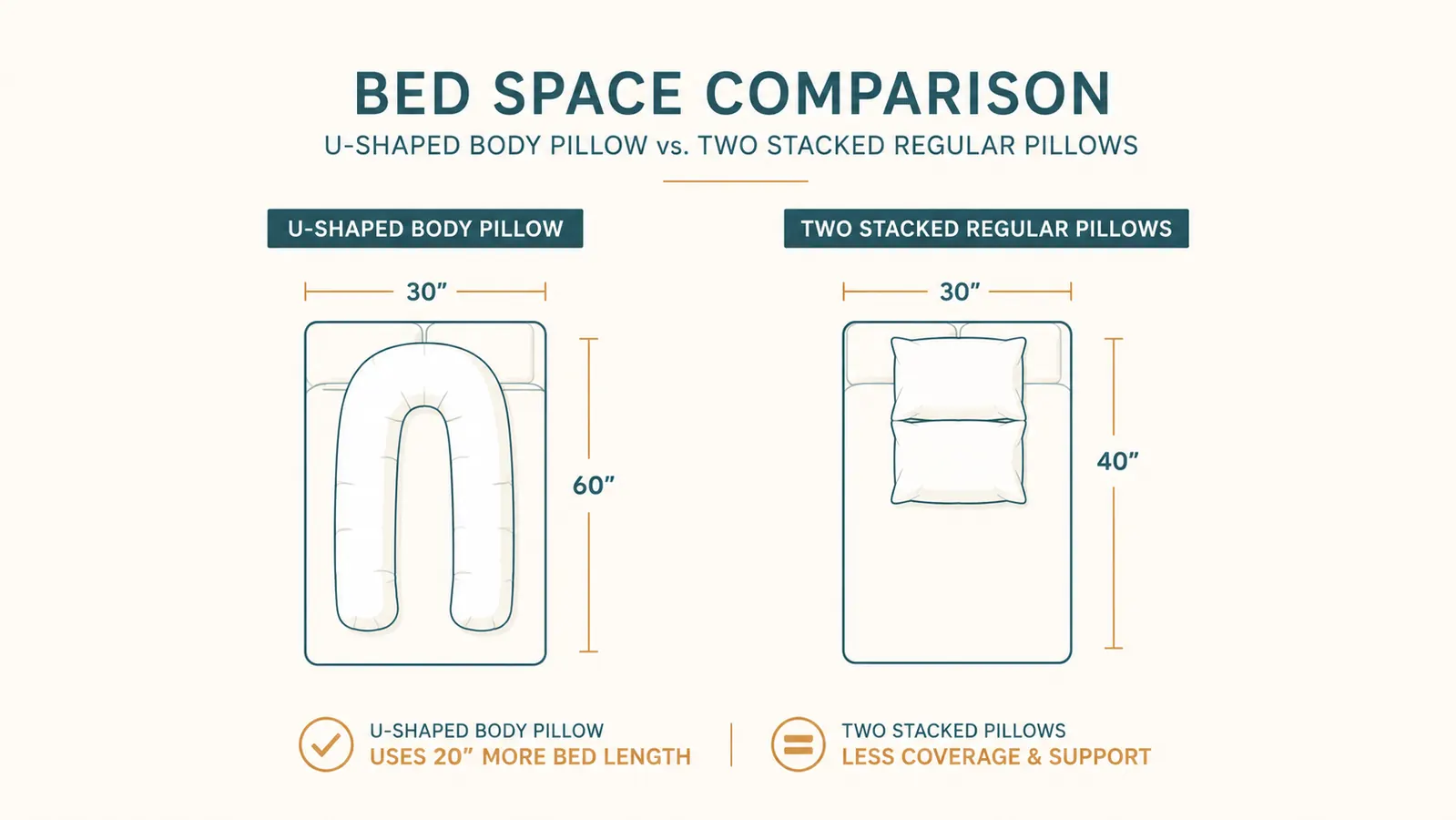
Here's the thing the product photos conveniently leave out: this pillow takes over your bed. On a queen mattress, the U-shape eats close to a third of the usable sleeping surface once it's positioned around you. My husband, who was a good sport about the whole experiment, ended up sleeping on the very edge of his side for the first two weeks, muttering about needing a bigger mattress.
If you sleep alone or have a king bed, this is a non-issue. If you share a queen with a partner who already claims more than their half, budget for a real conversation before this pillow shows up. Danielle's husband works nights, so it wasn't a factor for her, but I heard from two other people in my sleep-gear group chat who bought this pillow and had their partner quietly relocate to the guest room within a week.
The other space issue is storage. When you're not using it, a 55-inch curved pillow doesn't fold flat or tuck under a bed easily. I ended up leaning mine against the wall in the corner of the bedroom during the day, which is fine if you don't mind the visual clutter, less fine if you were hoping to keep the room looking like an adult lives there. Danielle eventually bought a cheap floor basket just to corral hers during the day, which is a small extra cost nobody warns you about either.
The Smell and the Cover, Which Nobody Warns You About Either
Both pillows arrived with a noticeable new-fill smell straight out of the packaging, that slightly plasticky, warehouse-adjacent scent a lot of compressed polyester fill ships with. It wasn't overwhelming, but it was there, and if you're pregnant and dealing with heightened smell sensitivity like Danielle was, I'd let it air out in a spare room for a day before sleeping on it. Ours faded within about 48 hours with the cover off and a window cracked.
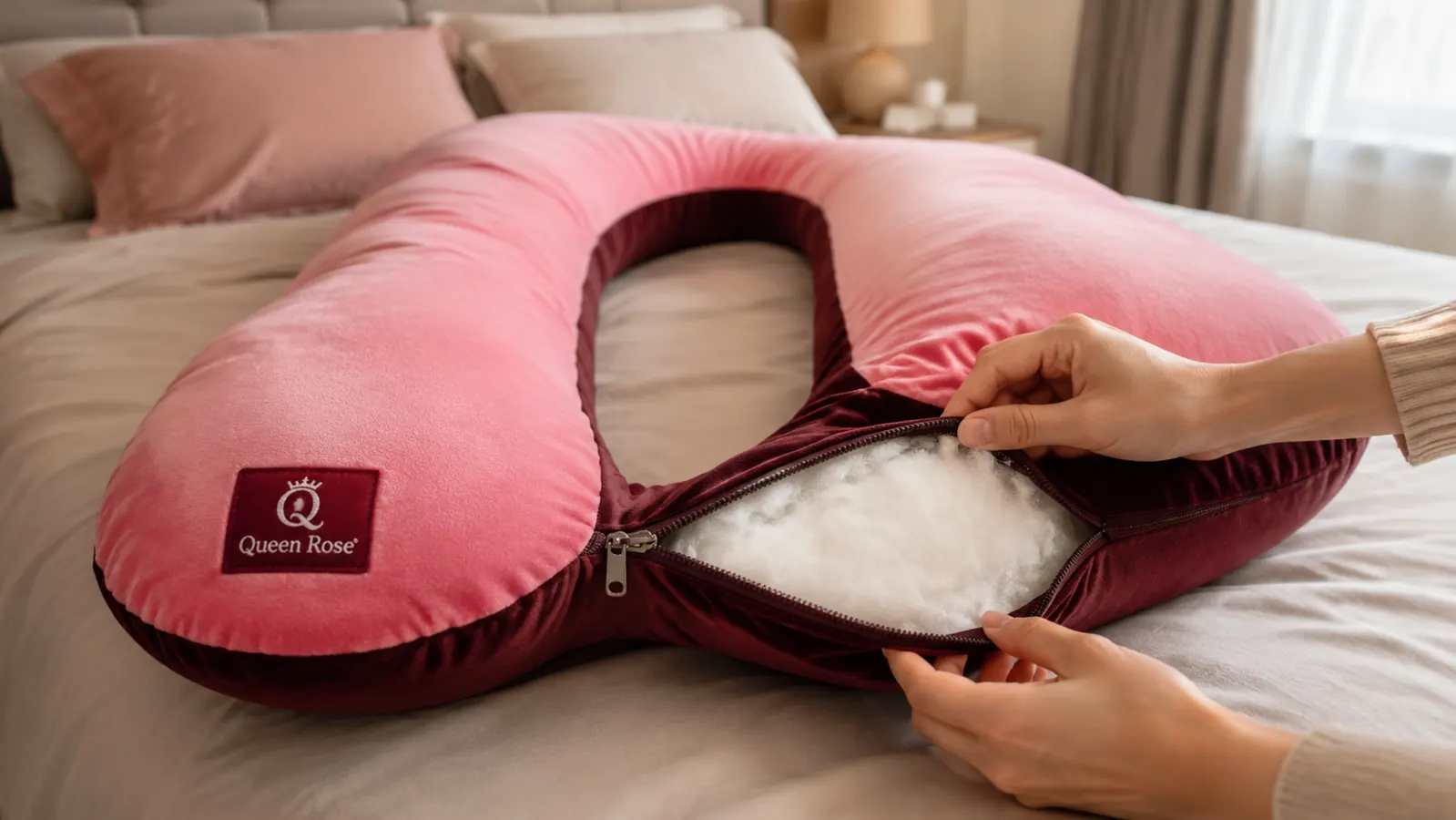
The cooling silky cover is genuinely nice against the skin, smoother and more slippery than I expected from a budget accessory, and it does feel noticeably cooler to the touch than a standard cotton pillowcase. That part of the marketing holds up. What the listing doesn't emphasize is that removing and replacing the cover for washing is a two-person job the first few times. The zipper runs the entire length of the U-shape, and wrestling a 55-inch fill back into a fitted cover solo, at 11 p.m., after a long day, is not a fun ten minutes.
Washing itself is straightforward, machine washable on cold with a low-heat tumble dry, but because of the size, it either needs a large-capacity washer or a trip to the laundromat. My standard home washer handled it fine, though it came out slightly lumpy in spots until I fluffed and reshaped it by hand after drying. Not a dealbreaker, just another thing the box doesn't tell you, and something I'd factor in before assuming weekly washing is realistic.
Does It Actually Help With Hip and Back Pain, or Is That Just Placebo
This is the question Danielle actually cared about, and it's the one I was most skeptical of going in. My honest read after six weeks: yes, but not as a miracle, more as consistent mechanical support that does what four separate pillows were doing badly. The curve of the U keeps your knees, hips, and belly (or lower back, in my case) aligned in one continuous shape instead of you having to constantly readjust three different props through the night.
For Danielle specifically, the belly support arm made the biggest difference. Third-trimester side sleeping without something under the belly puts real strain on the lower back and pelvis, and having that weight cradled instead of hanging changed how she felt getting out of bed in the morning. She went from stiff and slow to, in her words, "almost normal," within about ten days of consistent use, and she stopped needing the extra lumbar pillow she'd been wedging behind her back.
For my hip bursitis, the improvement was real but more modest. The pillow keeps my top leg elevated and separated from the bottom one, which is the exact positioning a physical therapist once drew on a napkin for me years ago. It reduced how often I woke up in pain, roughly from four or five nights a week down to one or two. It did not eliminate the underlying issue, and I don't think any pillow honestly could, so I'd caution anyone expecting it to replace actual treatment.

Where It Falls Short
Heat is the biggest ongoing complaint, and it's the one thing I'd flag loudest to anyone considering this. Despite the cooling cover, the sheer volume of fill wrapped around your body traps heat, especially if you're already running warm from pregnancy hormones or, in my case, a bedroom with mediocre airflow. Danielle solved it by keeping her bedroom fan on low all night. I ended up kicking a leg out from under the loop most nights just to vent some heat, which somewhat defeats the point of full-body support.
The fill also compresses over time in a way that's noticeable by week five or six. It's not falling apart, but the belly-support section in particular loses a little loft with nightly use, and by the end of my test period it wasn't cradling quite as firmly as it had on night one. Fluffing it by hand each morning helped, but it's a maintenance habit you have to build, not a set-it-and-forget-it product, and it's worth knowing that going in rather than being surprised by it a month later.
The zipper pull on the cover is small and a little flimsy for how much strain it takes each wash cycle. Mine hasn't broken over six weeks, but I could feel it was the weakest point every time I forced the fill back in, and I'd expect it to be the first thing to fail if you're washing this pillow every week or two through a full pregnancy. A cheap zipper repair kit or a bit of care during washing goes a long way here.
Price is the last honest note. At around forty dollars it's competitively priced against other full-body pregnancy pillows, but it's not the cheapest option on Amazon, and if all you need is knee separation and not the full belly-and-back wraparound, a smaller wedge or knee pillow will do the job for less money and take up far less bed. I'd rather tell you that upfront than let you buy the biggest option by default.
What I Liked
- Real, noticeable relief for hip and lower-back pressure within about a week
- Cooling silky cover feels genuinely cooler than standard cotton
- Belly support arm made a measurable difference for third-trimester sleep
- Machine washable, and durable enough to hold shape after weeks of nightly use
- Doubles as backrest support for reading or nursing once folded
Where It Falls Short
- Takes up roughly a third of a queen mattress once positioned
- Runs warm despite the cooling cover claim
- New-pillow smell needs a day or two to air out before first use
- Cover is genuinely difficult to remove and re-zip solo
- Awkward to store when not in use, no flat-fold option
It didn't fix my hip. It just stopped fighting me every single night, and after years of shuffling pillows around at 2 a.m., that alone felt like a win.
Who This Is For
If you're pregnant past the second trimester and side sleeping has stopped being comfortable no matter how you arrange your current pillows, this is worth the money, especially if you have a queen or larger bed to spare. It's also a solid pick for side sleepers dealing with hip or lower-back issues outside of pregnancy, since the alignment principle worked the same way for me as it did for Danielle. If you already run warm at night but sleep alone or have room to kick a leg free, the heat issue is manageable, and the adjustment period is worth pushing through past the first few nights.
Who Should Skip It
Skip this one if you're sharing a smaller bed with a partner who isn't on board with losing a third of the mattress, or if you tend to sleep hot and don't have a fan or cool bedroom to offset it. Back or stomach sleepers won't get much use out of the shape either, since the whole design is built around the side-sleeping curl. And if budget is tight, a smaller wedge or knee pillow solves the core alignment problem for a fraction of the price and none of the storage headache, without asking you to give up a third of your bed to get there.
Still deciding? See what's actually in the box before you buy
Check current pricing, available covers, and real buyer photos for the Queen Rose Pregnancy Pillow on Amazon.
Amazon Check Today's Price on Amazon →